ai-tools
Image to Prompt for Midjourney: A Structured Analysis
A structured, research-style analysis of image to prompt for Midjourney: why manual prompts fail and how reference-guided extraction improves results.

Abstract
This article examines image to prompt for Midjourney — the practice of deriving a structured textual prompt from a reference image in order to reproduce a target aesthetic in the Midjourney text-to-image system. We identify the central obstacle facing practitioners as a description gap: the disparity between a user's visual comprehension of an image and their ability to encode that comprehension in the specialized descriptive language Midjourney rewards. We characterize the linguistic features to which Midjourney is disproportionately sensitive, classify the common failure modes of manually authored prompts, and present a five-stage extraction-and-refinement procedure that mitigates the description gap. We further propose a nine-component taxonomy of prompt structure and discuss its diagnostic application. The analysis is intended for designers, computational artists, marketers, and commercial-imagery practitioners. We note throughout that reference-guided extraction is an assistive rather than autonomous method: verification and adaptation by the practitioner remain necessary.
Keywords: image to prompt for Midjourney, reference-guided prompting, vision-language models, prompt taxonomy, text-to-image generation
Table of Contents
- Introduction
- Background: The Distinctiveness of Midjourney Prompts
- Problem Statement: Failure Modes of Manual Prompts
- Method: A Reference-Guided Extraction Procedure
- Illustrative Cases
- A Taxonomy of Prompt Structure
- Recommended Practices
- Discussion: Limitations and Error Sources
- Frequently Asked Questions
- Conclusion
- References
1. Introduction
The reproduction of a specific visual aesthetic within a text-to-image system is a recurring and non-trivial task. A practitioner frequently possesses a reference image exhibiting a desired configuration of lighting, composition, and stylistic treatment, yet finds that iterative manual prompting fails to converge on a comparable result. This failure is commonly misattributed to the generative model. We argue instead that it originates in a description gap: the practitioner comprehends the reference visually but cannot articulate that comprehension in the descriptive register the model requires.
Image to prompt for Midjourney addresses this gap directly. Rather than requiring the practitioner to author expert descriptive language unaided, the method employs a vision model to produce an initial structured description of a reference image, which the practitioner then verifies and adapts for the Midjourney system. This article formalizes the method, situates it against the specific linguistic sensitivities of Midjourney, and provides a taxonomy for diagnosing and constructing effective prompts. The intended readership comprises designers, AI artists, marketers, and commercial-imagery practitioners who use Midjourney in production settings. A publicly available implementation of the extraction step is the Avriro Image to Prompt tool, referenced here as one instance of the general method.
2. Background: The Distinctiveness of Midjourney Prompts
A common but erroneous assumption holds that prompting conventions transfer uniformly across text-to-image systems. In practice, Midjourney exhibits sensitivities that differ from other generators, and effective prompt construction depends on accounting for them. We enumerate the principal features below.
2.1 Stylistic weighting. Midjourney responds strongly to stylistic descriptors (e.g., cinematic, editorial, matte painting). Such terms exert influence disproportionate to their length and frequently determine the overall character of the output more than object-level nouns.
2.2 Composition. Framing descriptors (e.g., rule of thirds, centered, wide shot) govern the spatial organization of the image. Their omission delegates compositional decisions to the model.
2.3 Camera specification. Angle and lens descriptors (e.g., low angle, overhead, macro) substantially alter perceived realism and intentionality. This class of descriptor is frequently omitted by inexperienced practitioners despite its high influence.
2.4 Lighting. Lighting descriptors (e.g., soft window light, chiaroscuro, high-key) encode a large proportion of an image's mood and are a principal determinant of perceived production quality.
2.5 Materials and color. Material descriptors (e.g., frosted glass, raw linen) and palette descriptors (e.g., muted earth tones) govern surface realism and chromatic consistency, respectively.
2.6 Aspect ratio. The --ar parameter constitutes a hard compositional constraint. Its syntax and permissible values are specified in the official Midjourney documentation [1].
2.7 Artistic reference. References to movements, media, and eras anchor an aesthetic efficiently. We note that Midjourney's policies concerning references to living artists have varied over time; consequently we recommend anchoring on movements and media rather than contemporary individuals [1].
The composite implication is that Midjourney rewards specific, structured, and visually literate language — precisely the register that practitioners without formal training in photography, cinematography, or design find difficult to generate unaided.
3. Problem Statement: Failure Modes of Manual Prompts
We classify the failure modes of manually authored prompts into five categories. The classification is diagnostic: each failure corresponds to a recoverable deficiency in the prompt.
F1 — Under-specification (genericity). The prompt supplies insufficient constraint (e.g., a product photo of a candle), yielding an averaged, non-distinctive output.
F2 — Omission of observed detail. The practitioner perceives attributes in the reference (e.g., directional lighting, shallow depth of field) but does not encode them, converting deterministic intent into stochastic outcome.
F3 — Absent or incorrect style term. In the absence of a stylistic descriptor, the model applies a default aesthetic that may diverge substantially from the reference.
F4 — Weak compositional specification. Without framing or camera descriptors, spatial organization is delegated to the model, frequently producing flat or awkwardly cropped results.
F5 — Absence of camera information. The omission of angle and lens descriptors is identified as a high-impact failure, given the strong contribution of these descriptors to perceived quality.
The unifying characteristic across F1–F5 is that the practitioner's visual comprehension exceeds their descriptive encoding. The deficiency is linguistic rather than perceptual, which motivates an assistive extraction method.
4. Method: A Reference-Guided Extraction Procedure
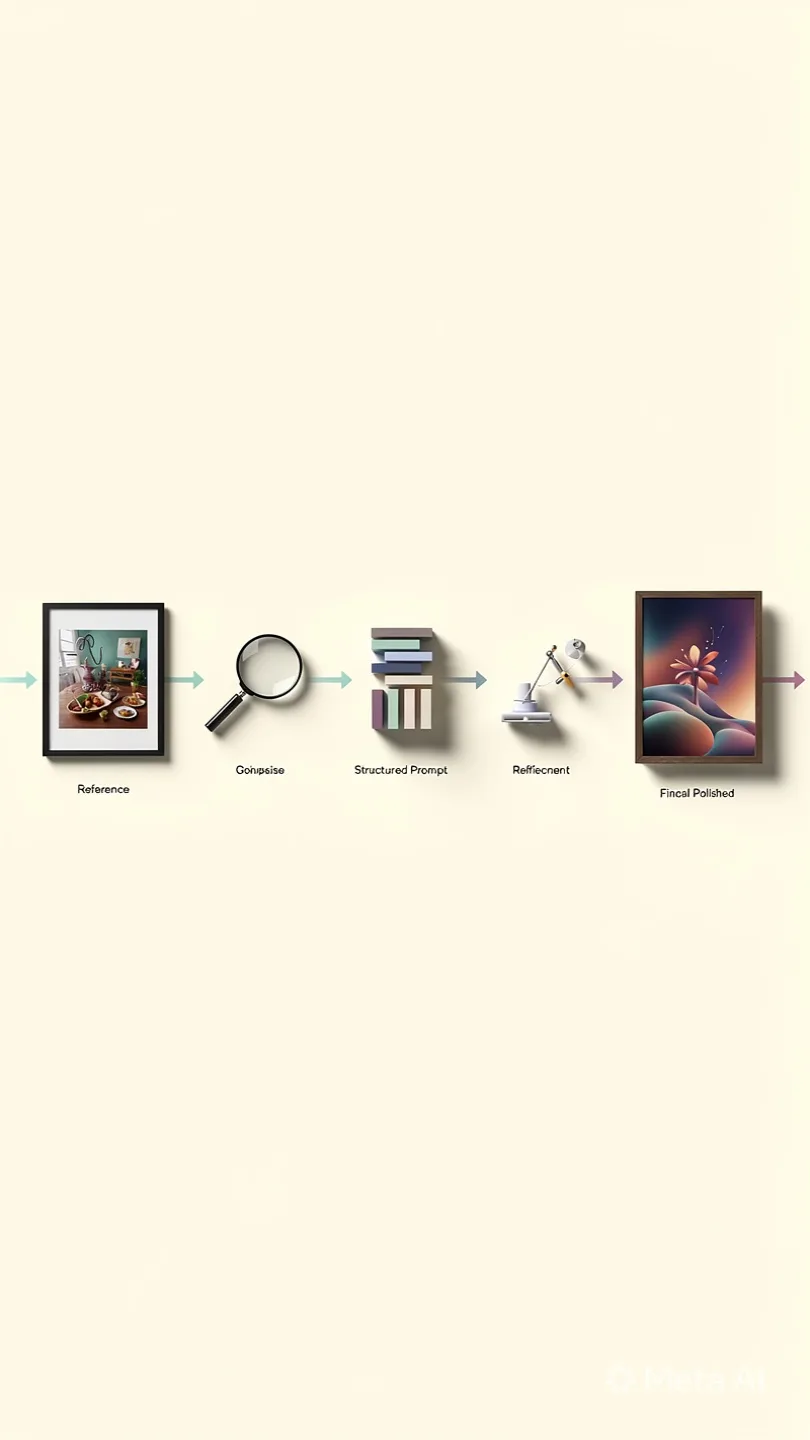
We present a five-stage procedure that mitigates the description gap by substituting an assisted first draft for unaided authorship.
Stage 1 — Reference selection. Select a reference image that clearly exhibits the target style, lighting, and composition. Input quality is a determinant of extraction quality; low-quality or cluttered references degrade the resulting description.
Stage 2 — Extraction. Submit the reference to an image-to-prompt system, which returns a structured description (typically comprising subject, setting, style, lighting, and, in many implementations, camera and mood attributes). This constitutes the initial draft and supplies the expert vocabulary identified as absent in Section 3.
Stage 3 — Critical verification. Compare the extracted description against the reference to identify (a) hallucinated attributes not present in the source and (b) omitted attributes present in the source. This stage is essential; vision-language models are known to introduce both error types (Section 8).
Stage 4 — Adaptation to the target register. Convert the verified description into Midjourney's preferred syntax: concise, comma-delimited phrases with salient elements front-loaded, and technical parameters (e.g., --ar) appended per the documentation [1].
Stage 5 — Generation and controlled iteration. Generate an output, compare it to the reference, and revise a single variable per iteration. Single-variable revision isolates the effect of each descriptor and supports incremental learning of the descriptor space.
The procedure's efficacy derives not from automation per se but from the substitution of an editing task for an authoring task. Revising an expert-level draft is cognitively less demanding than producing one, and repeated exposure to the extracted vocabulary produces incidental learning. A detailed treatment of the extraction stage in isolation is provided in a companion article on converting an image into an AI prompt.
5. Illustrative Cases
The following cases are illustrative constructions intended to demonstrate the reasoning of the procedure. They are not empirical trials, and no quantitative performance claims are made.
Case A — Commercial product image. Consider a reference depicting a matte ceramic vessel on a linen surface under soft directional window light, photographed from slightly above eye level with shallow depth of field. A representative under-specified prompt (F1) is ceramic mug on a table. An adapted extraction is: matte cream ceramic mug on raw linen surface, soft directional window light from the left, gentle shadows, shallow depth of field, slightly high angle, minimal editorial product photography, warm neutral palette --ar 4:5. The adapted form supplies material, lighting direction, camera, and style descriptors absent from the baseline, converting under-specified intent into explicit constraint.
Case B — Low-key portrait. For a reference exhibiting a single hard key light and pronounced shadow, an under-specified prompt is portrait of a woman, dramatic. An adapted extraction is: close-up portrait, single hard key light, deep chiaroscuro shadows, dark neutral background, film grain, cinematic color grade, low angle, 85mm lens feel --ar 2:3. The descriptors chiaroscuro and single hard key light encode the lighting logic that the baseline omits (F5, F3).
Case C — Flat-lay for commercial catalog. For an overhead arrangement on a pastel ground, an under-specified prompt is skincare products flat lay. An adapted extraction is: overhead flat lay of skincare products, soft pastel background, even diffused lighting, clean negative space, pastel color palette, minimal commercial styling, crisp focus --ar 1:1. The descriptor even diffused lighting addresses the shadow artifacts characteristic of under-specified flat-lay prompts (F2).
Across cases, the adapted prompts differ from their baselines principally in the presence of material, lighting, camera, and style descriptors — consistent with the failure taxonomy of Section 3.
6. A Taxonomy of Prompt Structure
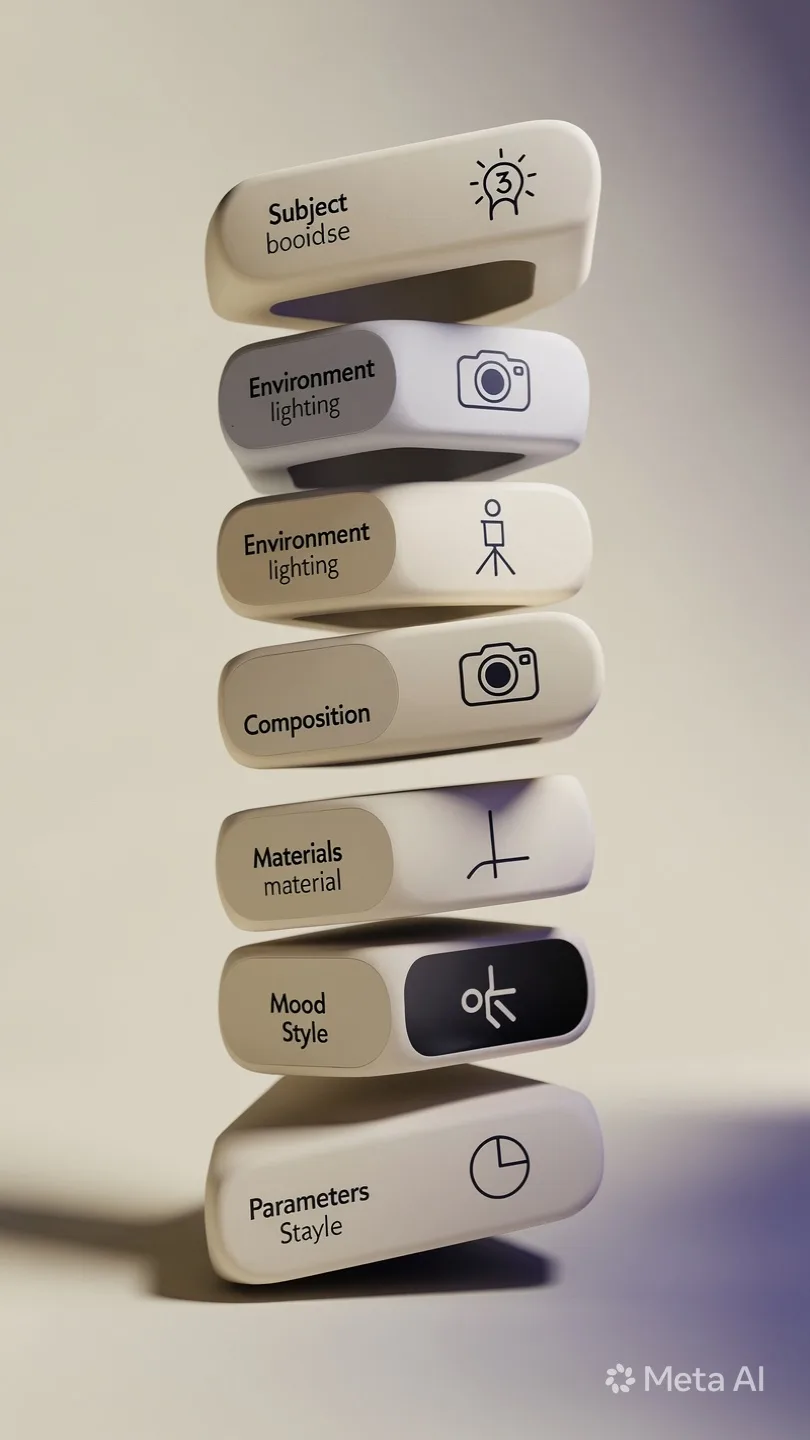
We propose that an effective Midjourney prompt decomposes into nine components. The taxonomy serves both constructive and diagnostic purposes: it guides authorship and localizes deficiencies in underperforming prompts.
- Subject — the principal depicted entity.
- Environment — setting or background.
- Lighting — direction, quality, and mood of illumination.
- Camera — angle and lens characteristics.
- Composition — spatial organization of the frame.
- Materials — surface and texture attributes.
- Mood — intended affective tone.
- Style — aesthetic or medium reference.
- Parameters — technical flags (e.g.,
--ar) per documentation [1].
Not all components are obligatory for a given prompt; the taxonomy's value lies in requiring a deliberate decision regarding each. For diagnostic use, an underperforming prompt is examined component-by-component; empirically, the most frequently omitted high-impact components are lighting, camera, and style (cf. Sections 2 and 3).
7. Recommended Practices
The following practices follow from the preceding analysis.
- Employ high-quality references. Input quality bounds extraction quality; isolate cluttered subjects prior to extraction, for which a background remover is suitable.
- Front-load salient descriptors. Given Midjourney's positional weighting, place subject and style early.
- Specify camera angle in all prompts. This high-impact component is frequently omitted (F5).
- Specify lighting explicitly. Lighting is a principal determinant of mood and perceived quality.
- Prefer concise, comma-delimited phrasing over extended prose.
- Set aspect ratio deliberately via
--arrather than accepting defaults. - Verify and edit every extracted draft to remove hallucinated attributes (Stage 3).
- Vary a single descriptor per iteration to isolate effects (Stage 5).
- Anchor style on movements and media rather than living individuals, consistent with current guidelines [1].
- Maintain a prompt repository to support stylistic consistency across a series through structural reuse.
8. Discussion: Limitations and Error Sources
The method is assistive, not autonomous, and several limitations warrant explicit statement.
8.1 Extraction error. Vision-language models may introduce hallucinated attributes or omit present ones. This is the principal source of error in the pipeline and motivates the mandatory verification stage (Stage 3). Practitioners should not treat extracted descriptions as ground truth.
8.2 Register mismatch. Extracted descriptions are frequently expressed as natural-language description rather than in Midjourney's comma-delimited register. Direct transfer without adaptation (Stage 4) typically yields suboptimal results.
8.3 Reproducibility. Midjourney introduces stochastic variation by design. Structural reuse of a prompt yields stylistic consistency but not identical outputs; exact reproduction of a reference is not an attainable objective, and visual equivalence is the appropriate goal.
8.4 Version dependence. The descriptive vocabulary (lighting, camera, style, materials) is largely version-invariant, whereas technical parameters follow the current Midjourney syntax and should be verified against the documentation [1].
8.5 Residual practitioner burden. The method reduces but does not eliminate the practitioner's role. Verification, adaptation, and the supply of intent remain necessary and constitute the locus of creative judgment.
9. Frequently Asked Questions
How does image to prompt for Midjourney work?
A reference image is submitted to a vision-based system that returns a structured textual description; the practitioner verifies and adapts this description into Midjourney's syntax before generation.
Can a reference image be reproduced exactly?
No. The attainable objective is visual equivalence in style, lighting, and composition, not pixel-level reproduction, owing to the model's inherent stochasticity (Section 8.3).
Is editing of the extracted prompt necessary?
Yes. Verification and adaptation are mandatory stages (Stages 3–4); unedited transfer is a documented failure mode (Section 8.2).
Why are portions of a prompt disregarded by the model?
Typically because the prompt is over-specified or salient descriptors are positioned late; front-loading and pruning address this.
Which components are most influential?
Lighting, camera, and style exhibit the highest influence and are the most frequently omitted (Sections 2–3).
Is the method useful only for novices?
No. Experienced practitioners employ it for efficiency and for stylistic consistency across image series.
Can the method support brand consistency?
Yes. Extraction from an on-brand reference, followed by structural reuse, promotes consistency across a series (Practice 10).
Does a fixed prompt yield a fixed output?
No; stochastic variation persists. Structural reuse yields stylistic rather than exact consistency.
Is the method compatible with current Midjourney versions?
The descriptive vocabulary is largely version-invariant; only technical parameters are version-dependent (Section 8.4).
How does this differ from Midjourney's native image prompts?
Native image prompts blend a reference into a generation without producing editable text; the present method yields an editable, inspectable description, supporting both control and incidental learning.
10. Conclusion
We have characterized image to prompt for Midjourney as a method for mitigating the description gap between visual comprehension and descriptive encoding. The method substitutes an editing task for an authoring task by means of an assisted extraction stage, and its effectiveness is contingent on subsequent verification and adaptation by the practitioner. We provided a failure taxonomy (Section 3), a five-stage procedure (Section 4), and a nine-component structural taxonomy (Section 6) with diagnostic application.
Regarding tool selection, suitability is contingent on the use case. For commercial and product imagery integrated with adjacent operations — subject isolation, product listing generation, and virtual try-on — the Avriro Image to Prompt tool is well suited. For broad stylistic experimentation across heterogeneous references, a general vision-language model may be preferable; a comparative treatment is provided in our analysis of the best image to prompt generators. We make no claim of universal superiority for any single tool; the appropriate criterion is fitness for the specified use case.
11. References
Only verifiable primary sources are cited. No empirical studies are claimed.
[1] Midjourney. Midjourney Documentation. https://docs.midjourney.com/
[2] OpenAI. Vision — API Documentation. https://platform.openai.com/docs/guides/vision
[3] Anthropic. Vision — Claude Documentation. https://docs.anthropic.com/en/docs/build-with-claude/vision
[4] Google. Google AI for Developers. https://ai.google.dev/
[5] Black Forest Labs. Flux Documentation. https://docs.bfl.ai/